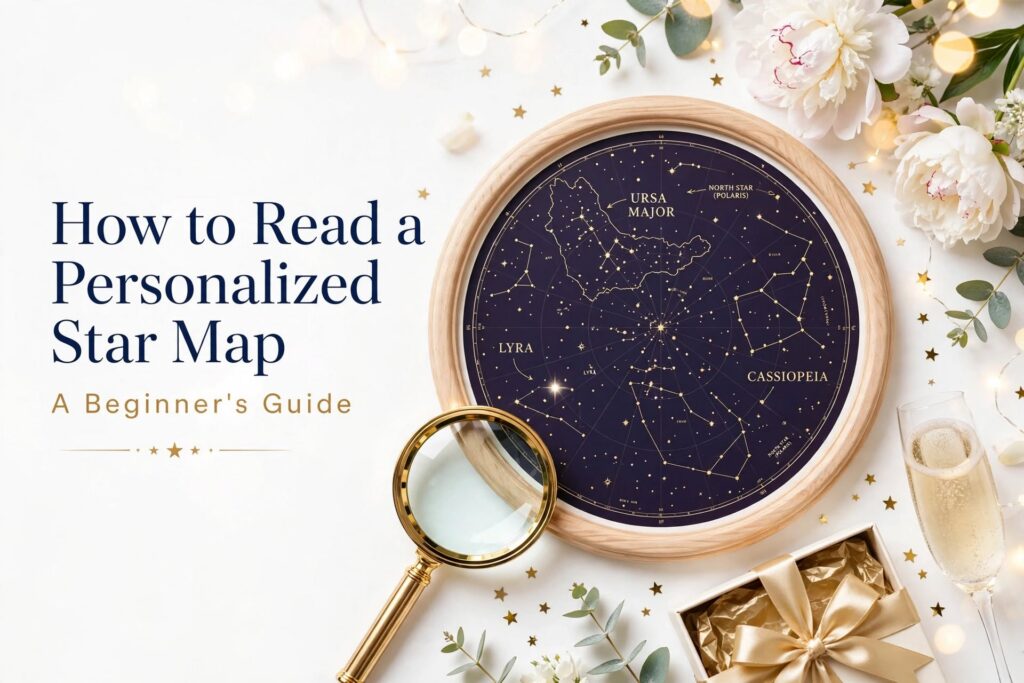
If you have ever wondered how to read a star map, you are not alone. A personalized star map can look like a beautiful collection of dots and lines at first. Once you understand what those details represent, it becomes a record of a chosen place and moment rather than simply celestial decoration.
This beginner-friendly guide explains the main elements of a star chart, what changes with the date and location, and what you should check when creating a personalized gift. It also explains what a decorative star map can—and cannot—tell you.
What does a star map actually show?
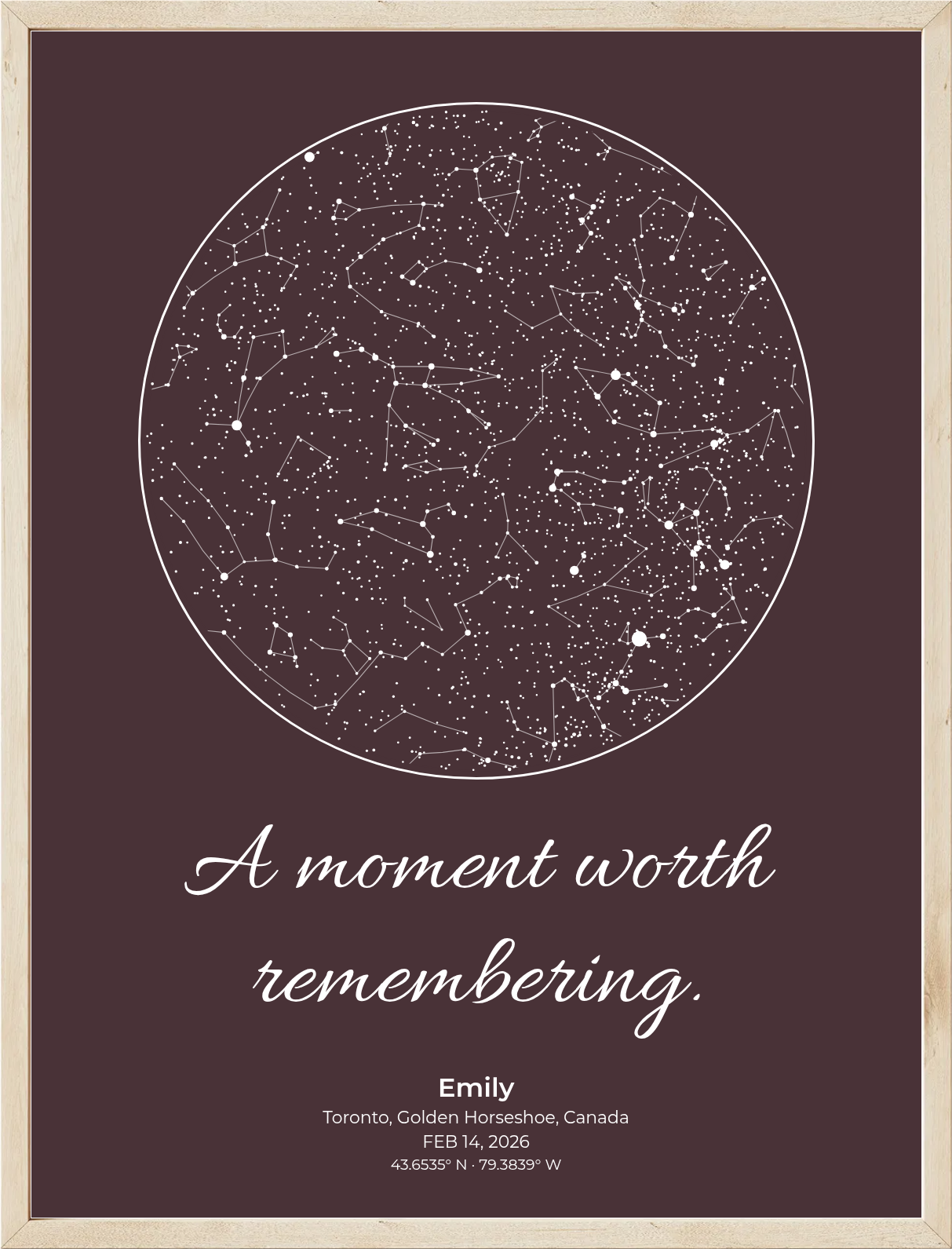
A star map is a representation of the sky from a particular perspective. Depending on the chart, it may show bright stars, recognizable constellations, celestial coordinates, and the boundary of the visible sky. A decorative gift design usually simplifies this information to keep the artwork readable.
The most important distinction is between a chart of the sky and a photograph. A star chart plots positions; it is not necessarily a photograph taken on the chosen date. Learning how to read a star map starts with knowing that the design is a representation, not a snapshot.
Five parts of a personalized star map to understand
1. Stars and points of light
Dots generally represent stars. Their apparent sizes may indicate relative brightness, but the exact visual treatment depends on the design. A large dot does not necessarily mean the star is physically larger or closer to Earth. Star brightness as seen from Earth and a star’s actual size are different things.
2. Constellations and connecting lines
Some charts connect stars with lines to outline familiar constellations. These lines are a human convention that makes patterns easier to recognize; they are not physical connections between stars. Not every personalized design displays constellation lines.
3. The horizon or circular boundary
Many star charts use a circle to represent a portion of the sky. Depending on the projection, the edge may represent the horizon and the center may point overhead, toward the zenith. The exact meaning depends on the chart’s projection, so check the creator’s labeling rather than assuming every circle works the same way.
4. Date and time
The sky you can see changes over the course of a night and across the year. Earth rotates, so stars appear to move across the sky; Earth’s orbit also changes which regions of the night sky are prominent in different seasons. If a chart is intended to represent a particular moment, its time setting matters.
5. Location
Latitude affects which stars can appear above the horizon, while longitude and local time influence how a chart corresponds to a moment. A map created for London may differ from one created for Toronto on the same date. Choose the place connected to your memory rather than a random nearby country.
How to read a star map step by step
- Read the label first. Confirm the occasion, date and location shown on the design.
- Find any direction markers. If north, south, east or west are labeled, use them to orient the chart.
- Look for recognizable patterns. Constellation lines can help you identify groups of stars, when the design includes them.
- Check the time. Understand whether the map represents an exact known moment or an approximate time you selected.
- Interpret it as a chart. The illustration may omit faint stars or other sky objects for visual clarity.
Can you identify your zodiac sign on a star map?
Sometimes you may recognize constellations associated with zodiac names, but the presence or position of a zodiac constellation in a chart is not the same thing as a horoscope. Astrology and observational astronomy are different systems. A personalized star chart should not be interpreted as a prediction about someone’s personality or future.
Why your star map may look different from a phone sky app
Different sky tools can use different projections, orientation conventions, time zones, levels of detail, and settings for constellation lines. A phone app may also show planets or atmospheric effects that a simplified gift design omits. If two views look different, compare their exact date, time, coordinates, and projection before deciding one is wrong.
For a deeper introduction to recognizing objects in the sky, explore NASA’s skywatching resources. They explain practical observing concepts without treating decorative maps as photographs.
How to choose a meaningful date for your design
A birth date, first date, proposal, wedding day or anniversary can all work. The best date is not necessarily the most dramatic event; it is the moment the recipient will recognize. If you do not know the exact time, choose an approximate time intentionally and avoid claiming the result is an exact record of an unknown minute.
You can explore the SkyMapGifts creator and see how your choices shape the design. For more gift inspiration, visit our birthday star map or wedding star map pages.
How to make a star map easier to understand as a gift
A short caption can give the chart its emotional context. “The sky on the day you were born” tells a clear story. “Where our story began” works for a first meeting or first date. Include the location and date in the design where possible, and choose readable text rather than crowding the image with multiple long quotations.
SkyMapGifts provides a digital PDF download. It is not a framed print delivered to your home. After purchasing, you can download the file and arrange printing and framing yourself. Review the preview and spelling before completing your order.
Frequently asked questions about reading star maps
Is a personalized star map a photograph of the night sky?
No. A star map is a plotted representation of the sky based on selected information, not necessarily a photograph taken at that time.
Do the lines between stars exist in space?
No. Constellation lines are visual guides that help people recognize familiar star patterns.
Does the time of day change the star map?
Yes. The sky’s orientation changes as Earth rotates. A chart may represent stars that are above the horizon even when daylight prevents you from seeing them.
Can I print a personalized star map at home?
Yes. SkyMapGifts offers a downloadable digital PDF that you can print yourself or through a printing service.
Turn your sky into a meaningful keepsake
Once you know how to read a star map, the dots and patterns become easier to appreciate. Start with a meaningful moment, check the date and place, and create your personalized star map to tell that story in a downloadable design.